Composition engineering of Ni-Co hydroxide for active and stable glycerol oxidation
An MSc thesis at the Henry Royce Institute exploring how Ni–Co bimetallic hydroxides — electrodeposited onto FTO glass — can valorise crude biodiesel glycerol while lowering the energy cost of green hydrogen.
Henry Royce Institute · Imperial College London — Dr. Reshma Rao
MSc Researcher · Synthesis, characterisation & electrochemical testing
2025
01
Ni₀.₀₇₅Co₀.₀₂₅(OH)₂
Optimal catalyst composition
02
1.01 kΩ
Charge-transfer resistance — minimised
03
≈10×
Rct improvement vs. pure Ni(OH)₂
04
48%
Projected rise in fossil-fuel demand (2012 → 2040, EIA)
Glycerol — a 10%-by-weight byproduct waiting for a job
The Energy Information Administration projects a ~48% rise in global fossil-fuel consumption between 2012 and 2040. Biodiesel offsets part of that demand — but it also produces crude glycerol as ~10% of its mass output. That glycerol has historically been waste, incinerated or sold at depressed prices.
Electrochemical glycerol oxidation flips the script: convert that waste into high-value chemicals (glyceraldehyde, glycolic acid, formate) while simultaneously lowering the energy needed to split water for green hydrogen. The bottleneck has been finding earth-abundant catalysts that are both active and stable.
Earth-abundant catalysts, alkaline conditions, real-world durability
Nickel and cobalt hydroxides are known to be active for glycerol electrooxidation in alkaline media — but their performance is exquisitely sensitive to composition, surface state and morphology. The brief: find the Ni : Co ratio that maximises activity and durability while staying within a scalable, low-cost electrodeposition route on FTO glass.
From bath to band — electrodeposition, then six characterisation techniques
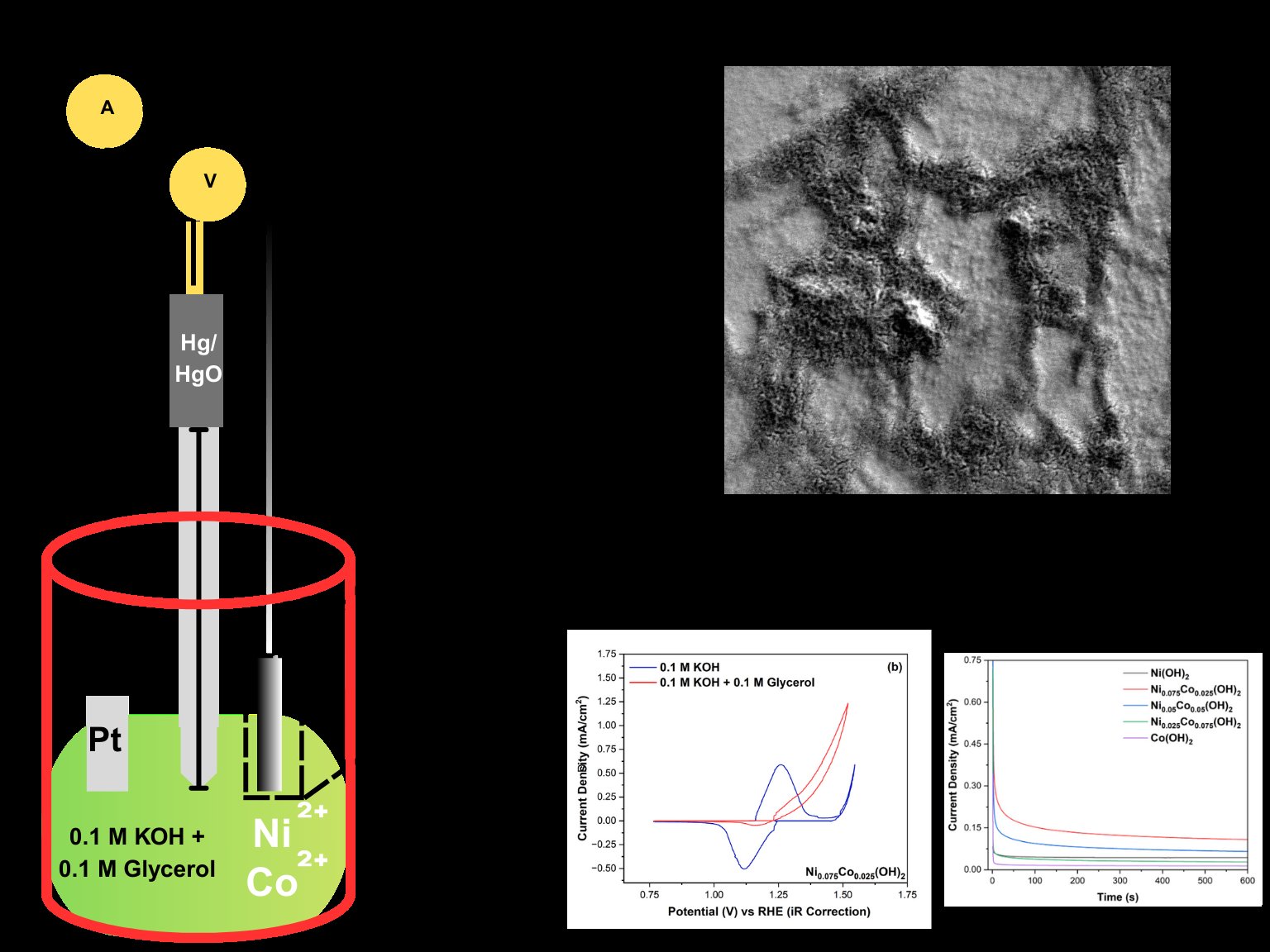
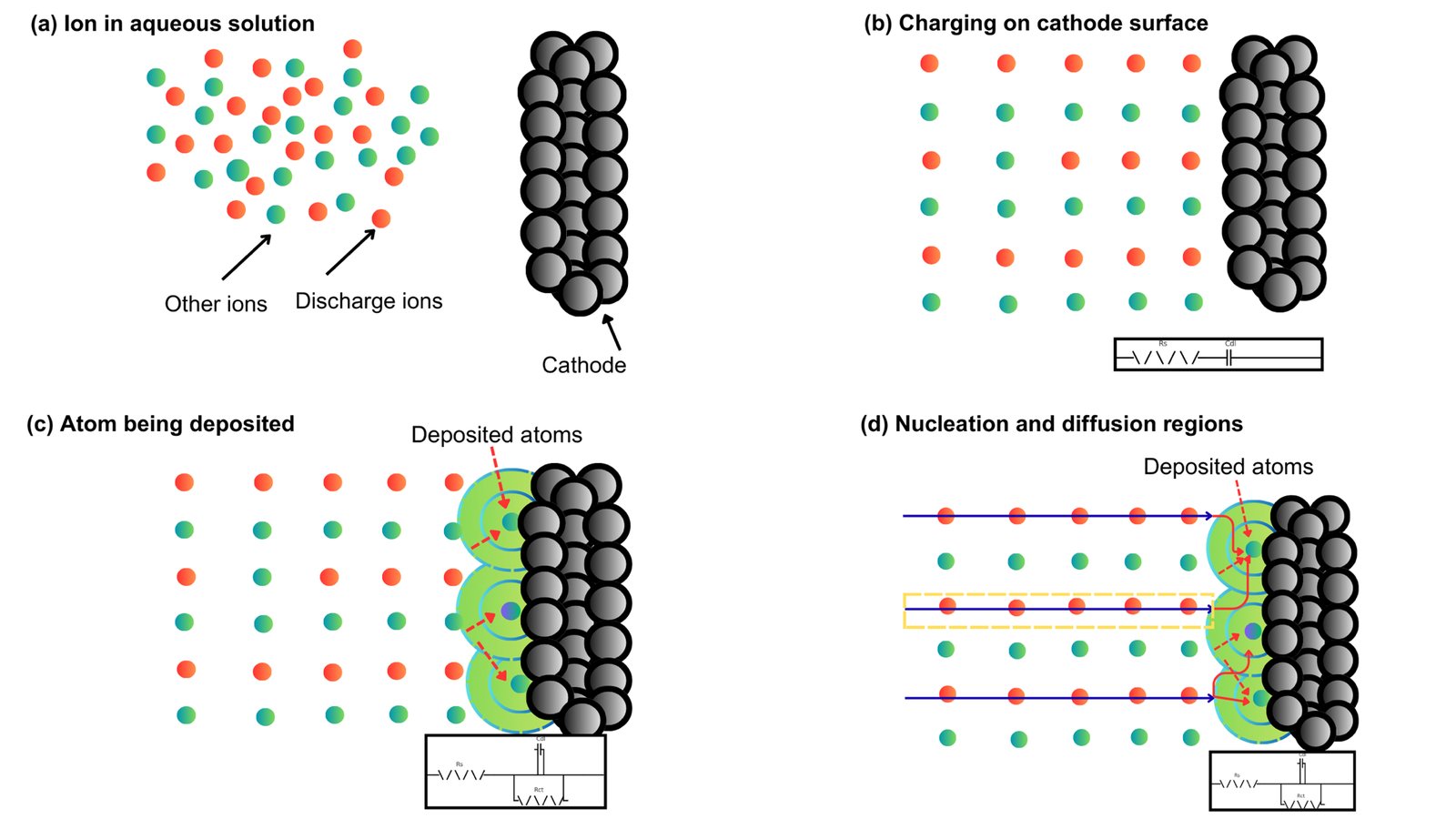
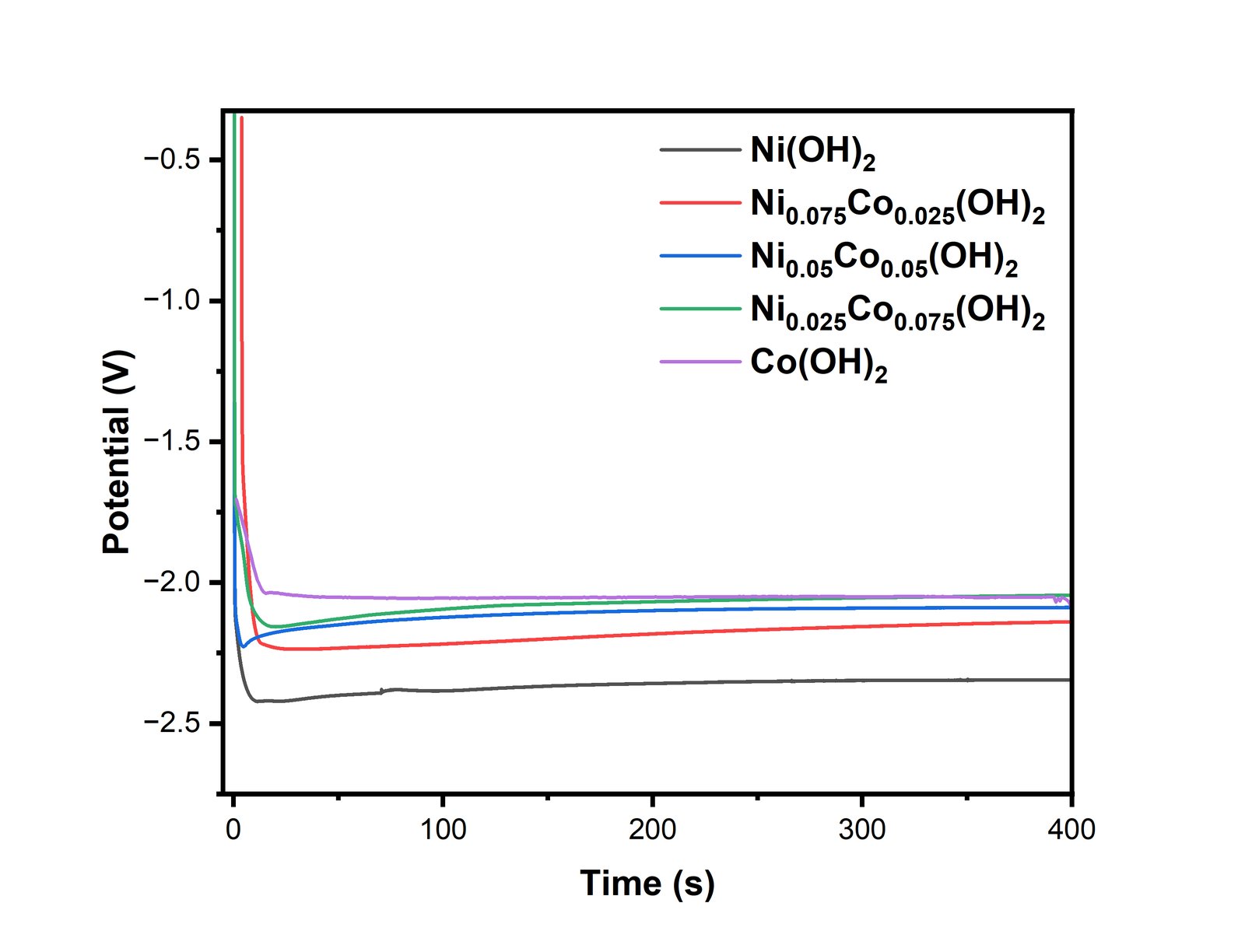
I fabricated NiₓCo_y(OH)₂ films by chronopotentiostatic electrodeposition (1 mA cm⁻² for 400 s) onto polished FTO substrates from aqueous nickel/cobalt nitrate baths of varying composition. After in-situ activation via CV staircase, each electrode passed through a full electrochemical and surface-state characterisation stack: CV, LSV (with iR correction and Tafel slopes), EIS, chronoamperometry, XPS (survey + high-resolution Ni 2p / Co 2p / O 1s), SEM and EDX.
Surface state and structure — what the spectra revealed
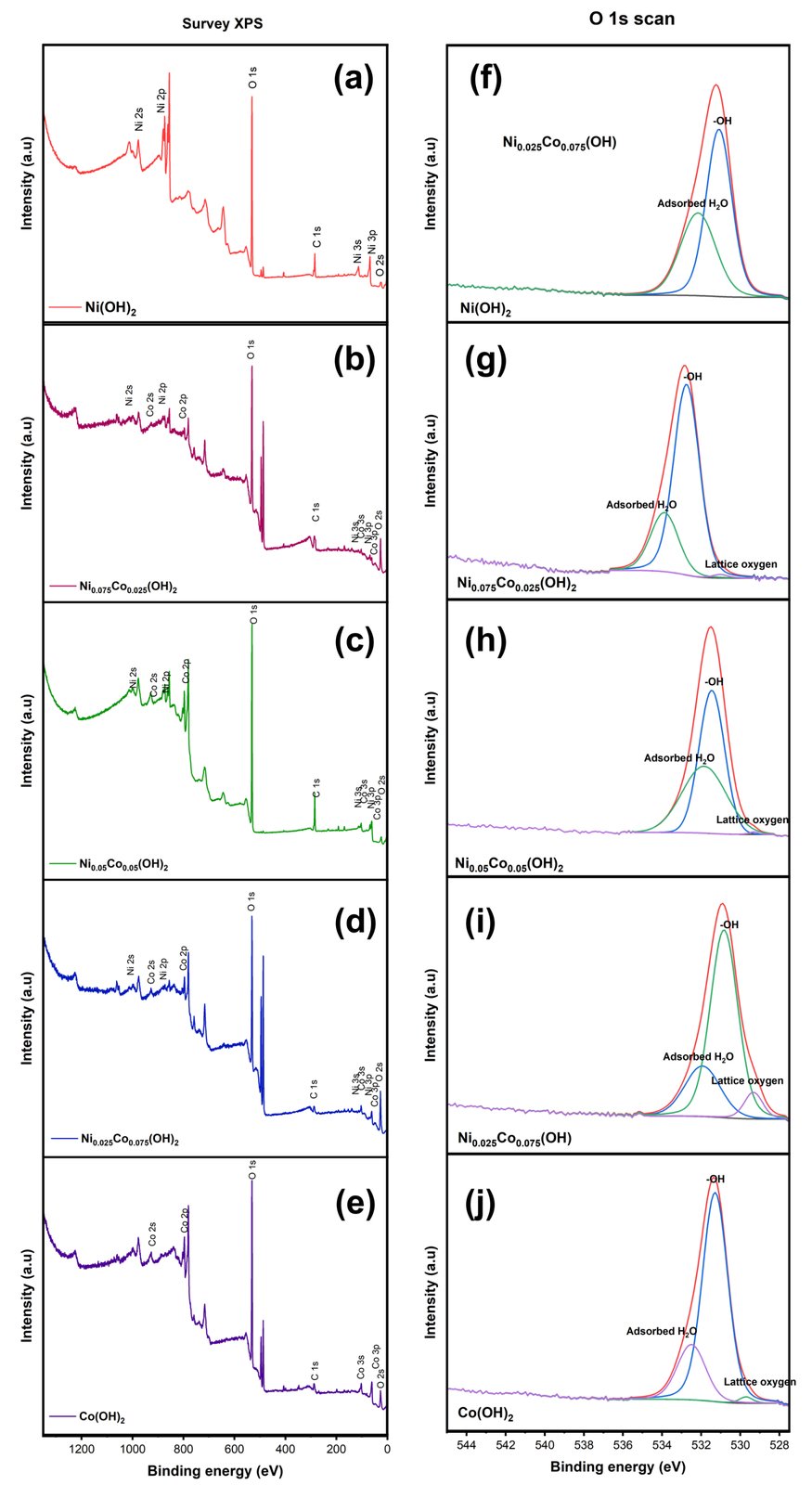
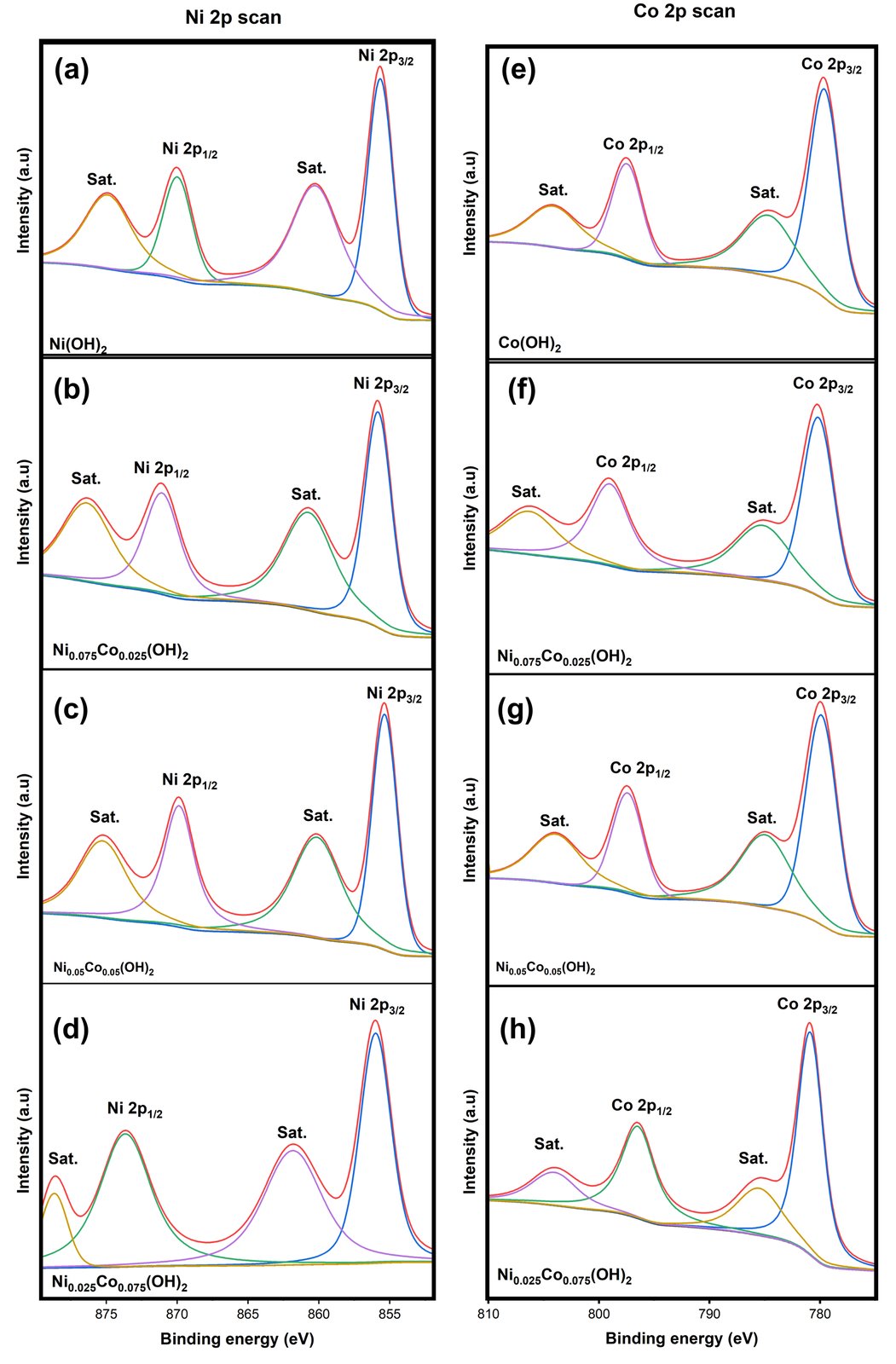
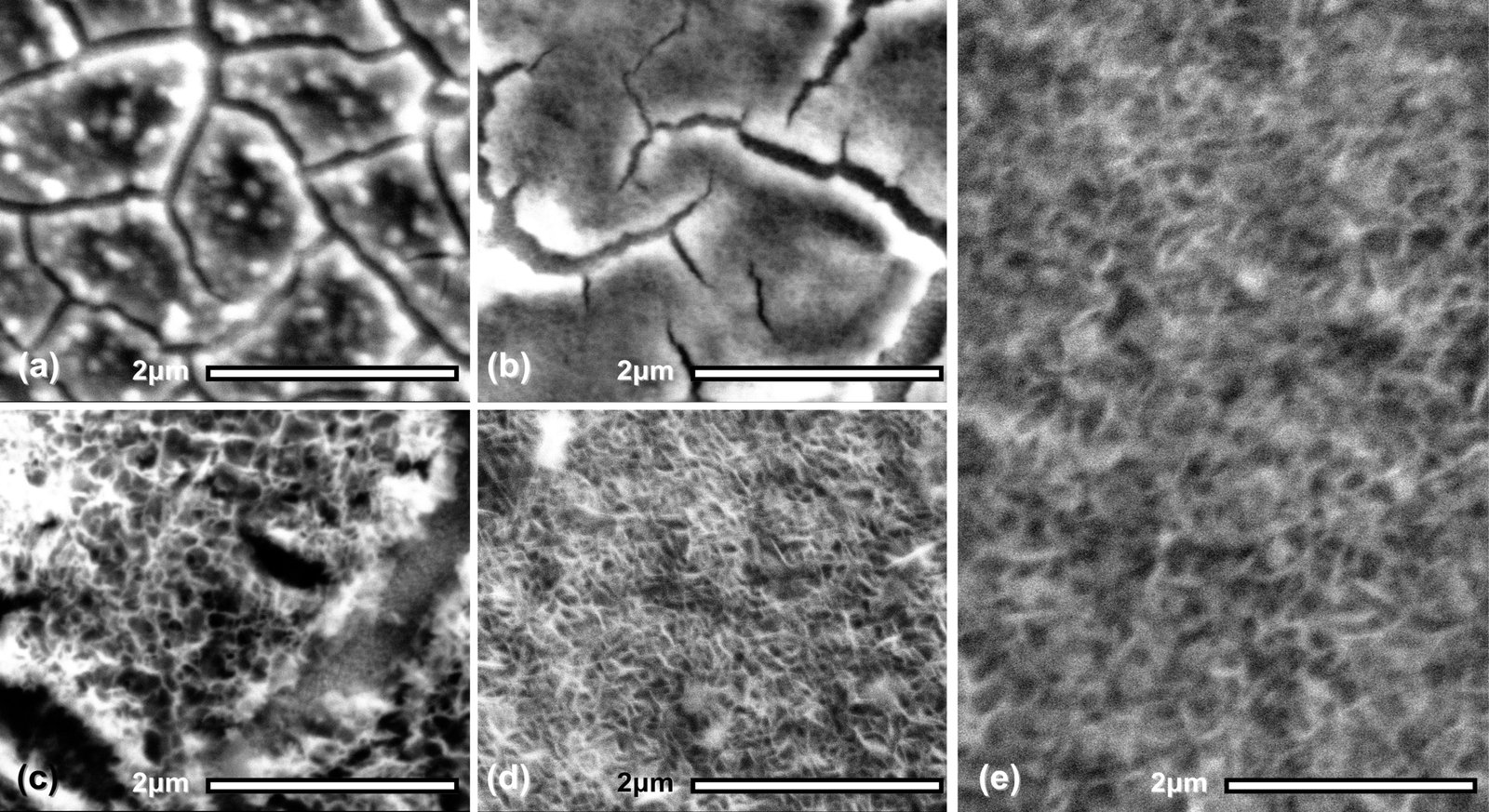
XPS confirmed that the bulk cobalt is present as Co(OH)₂ (no spinel signatures), and that increasing Ni content tunes the electronic environment around the active Ni³⁺ states — the species responsible for selective glycerol oxidation. SEM showed a sharp morphology shift from dense Ni(OH)₂ nanosheets to interpenetrating Co(OH)₂ nanoflakes as the Ni : Co ratio is decreased.
Activity, kinetics and durability
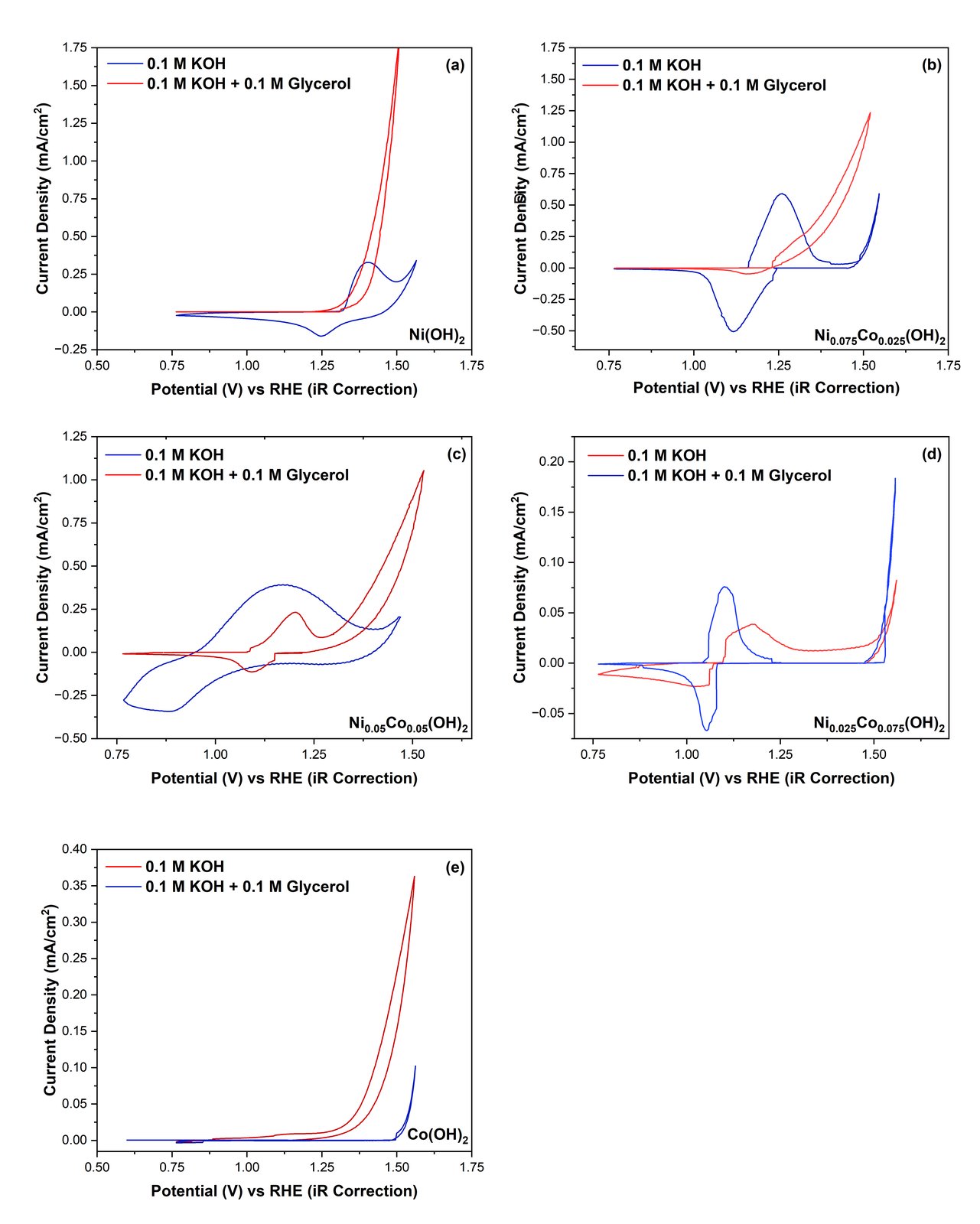
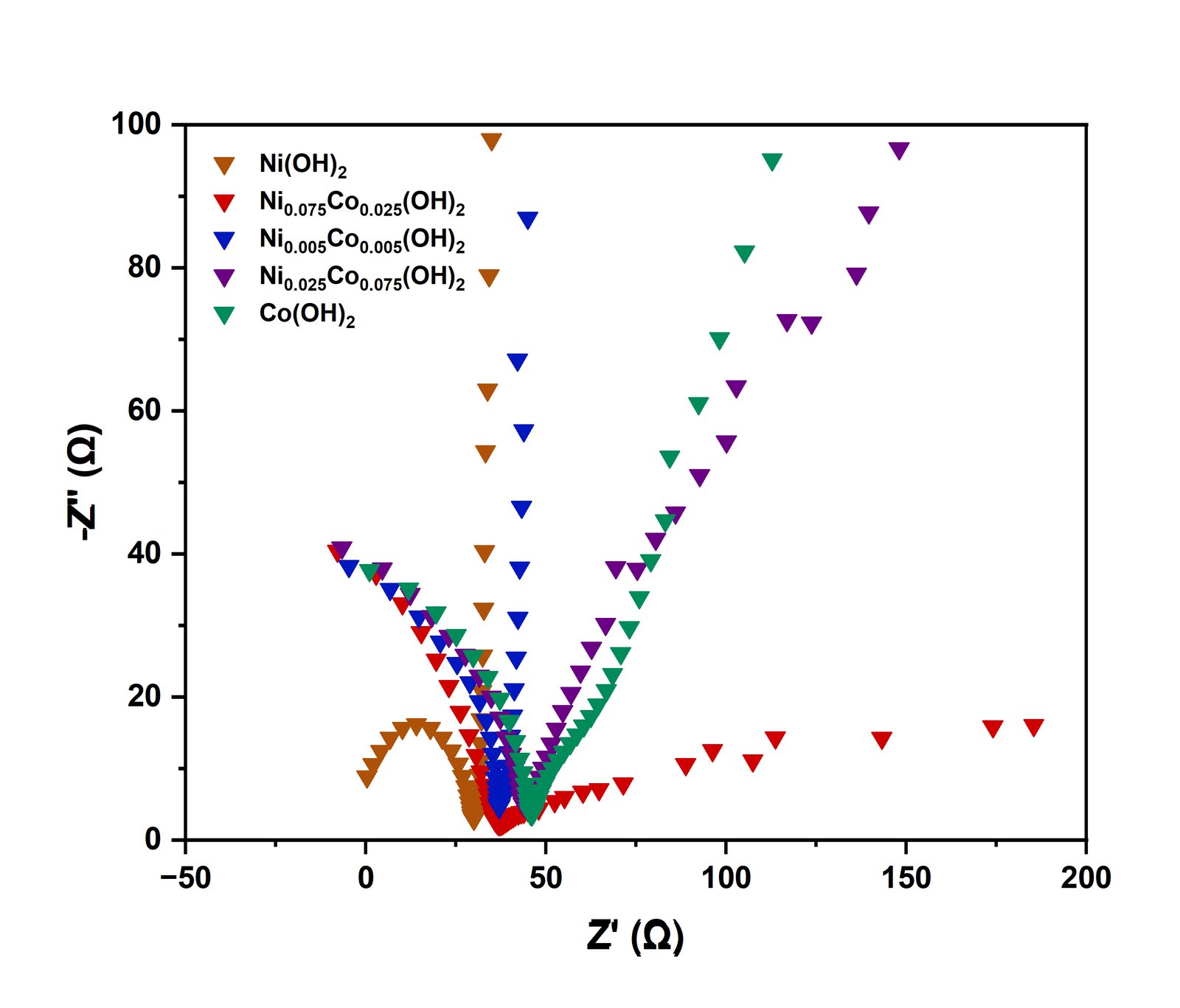
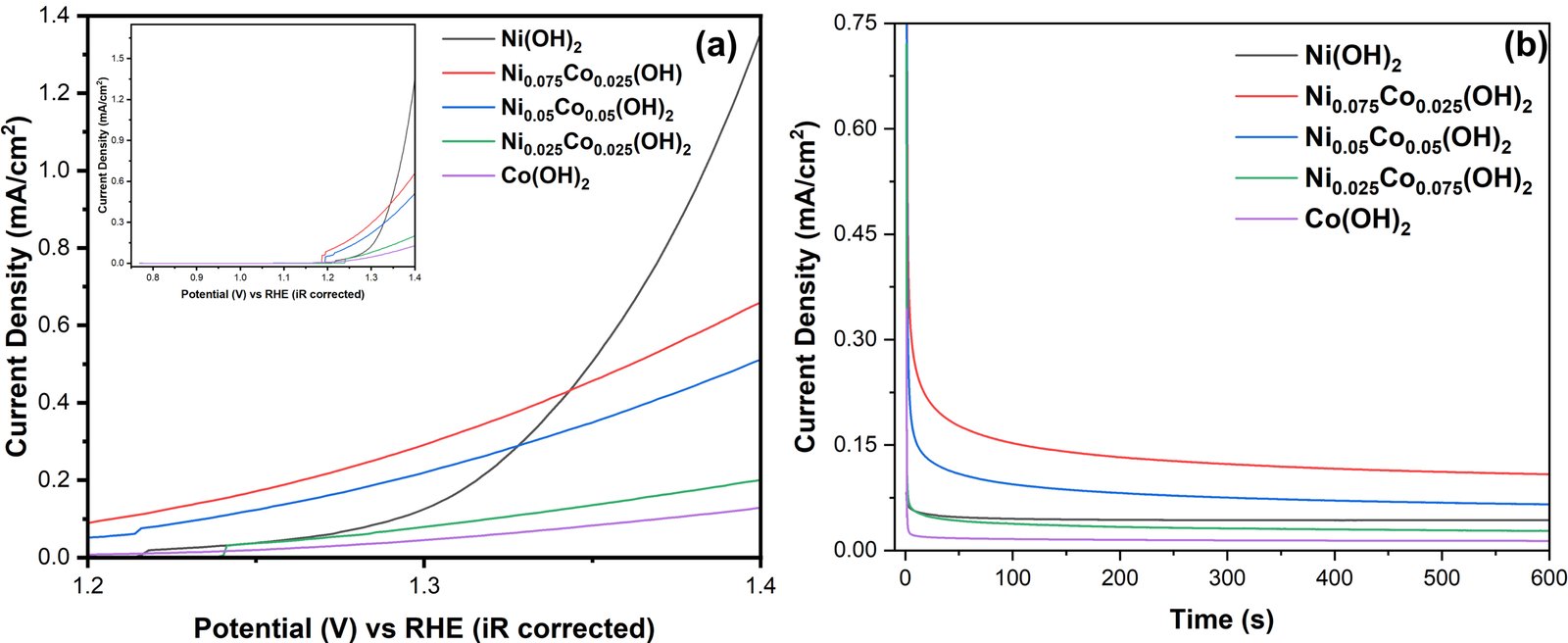
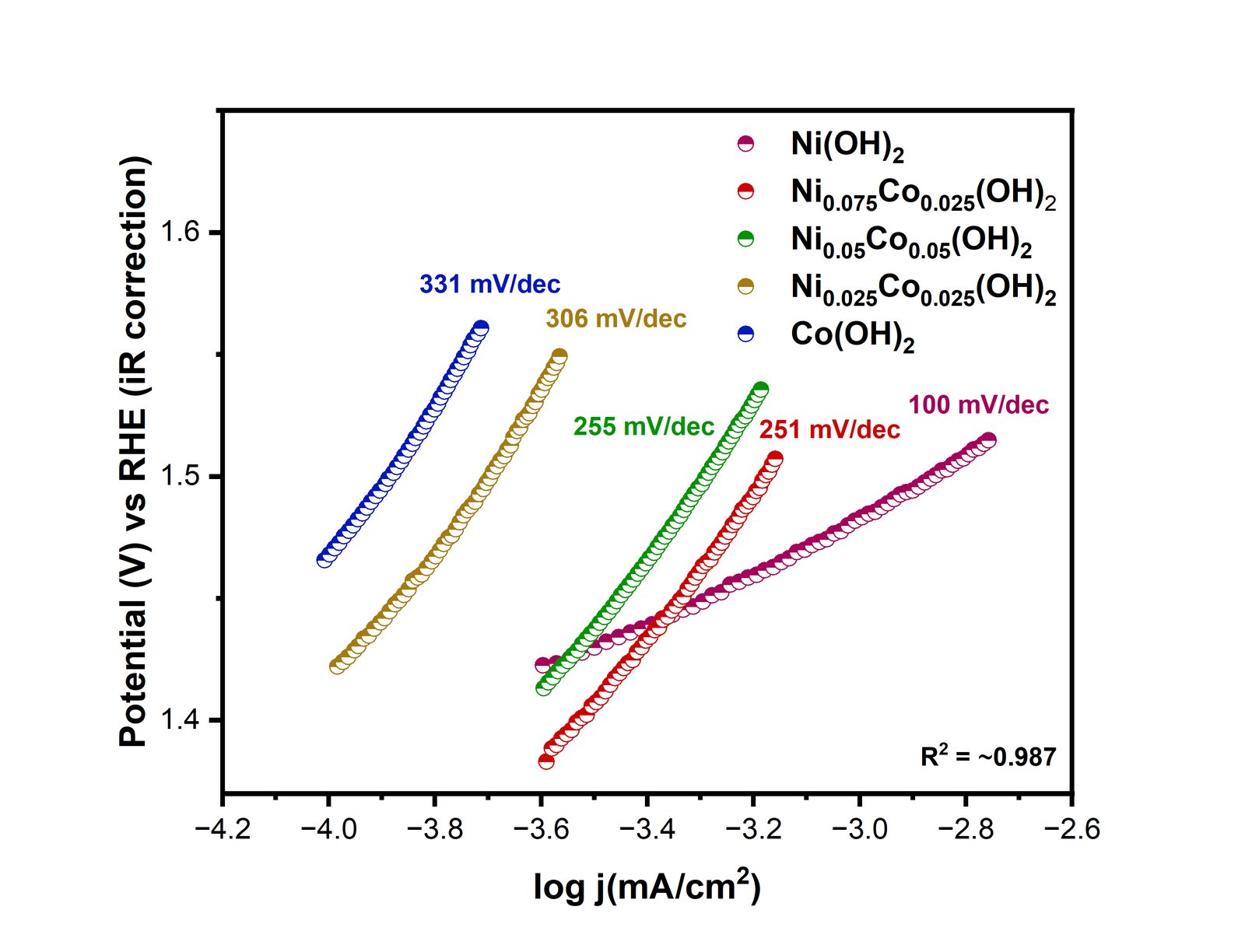
Cyclic voltammetry and linear-sweep curves showed that Ni₀.₀₇₅Co₀.₀₂₅(OH)₂ achieved the highest current densities at the lowest overpotentials for glycerol oxidation — and a Tafel slope consistent with a more facile rate-determining step. Nyquist analysis quantified the picture: charge-transfer resistance (Rct) dropped from ~10.9 kΩ for pure Ni(OH)₂ to ~1.01 kΩ at the optimal composition.
Chronoamperometric durability tests held the optimised electrode at constant potential for extended periods with negligible activity loss, confirming both intrinsic catalytic improvement and structural stability.
- Optimal composition: Ni₀.₀₇₅Co₀.₀₂₅(OH)₂ — minimum Rct and best LSV / Tafel performance.
- Ni acts as the active catalytic centre; Co operates as a promoter via electronic modulation, not via direct oxidation.
- Open-source workflow documented for reuse as a standard Royce Institute lab protocol.
“Cobalt isn't the catalyst here — it's the lever. The activity lives on nickel; cobalt just changes what nickel is willing to do.”
— Thesis · Henry Royce Institute, Imperial College London (2025)
How the work held up.
- Electrodeposition onto polished FTO at 1 mA cm⁻² for 400 s across five Ni : Co compositions.
- Electrochemical stack: CV staircase activation, iR-corrected LSV, EIS, Tafel-slope analysis, chronoamperometric stability.
- Surface and structural characterisation: XPS (survey + high-resolution Ni 2p, Co 2p, O 1s), SEM imaging, EDX elemental quantification.
- Supervised by Dr. Reshma Rao at the Henry Royce Institute, Department of Materials, Imperial College London.